Post Five: Classicalism Wasn’t Classic Enough: The Austrian School

Hall, Mary. “The Austrian School of Economics .” Investopedia, Dotdash, 24 Jan. 2018, http://www.investopedia.com/articles/economics/09/austrian-school-of-economics.asp.

Summary: In the last post I talked about how Neoclassicalism is widely regarded as too simple to be accurate. But, there is a school of thought that humans are much too complicated to understand, and creating complex mathematical models only serves to confuse the issue. Instead, simple observations will lead to a good understanding of the economy.

This idea results in the Austrian school of thought. Instead of doing math, experiments, or even rigorous observation, they had a strategy of reasoning aloud in order to determine what was and wasn’t true. Although this didn’t work very well, and the Austrian school no longer really exists, they were the first to realize that the value of goods or services was truly subjective.

For example, one important classical idea was that of the gold standard for money. The Classicalists believed that value was inherent to an object, and so for paper money to have value it must be linked to something with inherent value, gold. The Austrians rejected this idea, and instead said that something was worth as much as someone was willing to pay for it.

Analysis: The Austrian school is interesting because of its radical simplicity, as well as the many innovative ideas it had, many of which have gone on to influence Neokeynesian and Monetarist schools of thought.

I still need a picture for this post, and this topic is very difficult to find images for, so here’s a picture from https://en.wikipedia.org/wiki/Austrian_School showing how the Austrians believed price is determined, not intrinsic: Effect of tariff

Post Four: the Neoclassicists

Versetti, Angel. “History of the Neoclassical Economics – Analysis of Failures of the Neoclassical Thought.” Academia, 2010.

Summary: Versetti is very critical of Neoclassicalism in his essay, but he provides a succinct and understandable definition of what Neoclassicalism is. He gives a list of three elements:

  1. People will behave rationally
  2. Demand for products is static
  3. The market is self-regulating

These three points lead to very easy mathematical models. Neoclassicalism has much simpler math than Neokeynesian models, and is still a somewhat accurate model of the economy.

Versetti says that Neoclassical thought has failed because those three assumptions are overly simplistic, and although the Neoclassicists have some good ideas, it is ultimately not a sufficiently powerful model. Not all literature agrees with this idea, or else Neoclassicalists wouldn’t exist, but Neoclassicism being simple and not a very accurate model seems to be the sentiment shared by many economists. For example, here’s a quote from a random guy I took from quotefancy.com because I need an image for this very dry not-image-heavy subject:

Analysis: Although Neoclassical economics is the least respected field of economics that still has a major presence today, it still has a very large influence on politicians and public policy, and is therefore important to understand. I think the reason for this is that simpler models create better talking points and easier public policy decisions – “the invisible hand will take care of it” is easier than “these differential equations say you need to raise taxes”.

That’s not to say that all Neoclassicists are stupid or corrupt, however. There are some subfields of Neoclassicism such as Monetarism, Neoclassical-Keynesian, and New Classical that are much more respected economic theories.

I feel like the hardest part of this paper will be fitting into 10 pages or whatever. Which is funny since three hours ago I thought I would have to start talking about Communism and Socialism to make the length.

Post Three: The Keynesian Cross and Neokeynesian Thought

Fonseca, Gonçalo L. “The Neo-Keynesians.” The History of Economic Thought, Institute for New Economic Thought, http://www.hetwebsite.net/het/schools/synthesis.htm.

Summary: I spent the last blog post talking about how Keynesian economics was the first will developed economic theory, but has been replaced by Neokeynesian ideas. This article describes the issues with simple Keynesian thought.

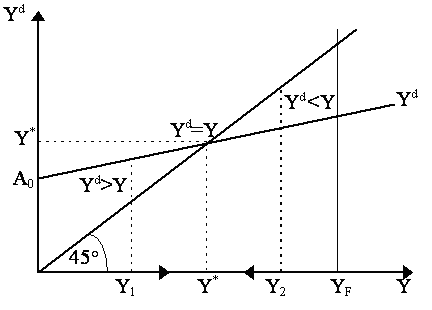
The big revelation Keynes had that was not present in the Classical school was that the market is not guaranteed to be efficient. Keynes said that supply will only ever reach demand, and that if demand is too low, supply will shrink, and 100% employment is not guaranteed. Keynes formalized this with something called the Keynesian Cross, which looks like this:

That image is taken from the same History of Economic Thought website I cited, from the article on the IS-LM model. It shows how supply, demand, and employment are related, as described by Keynes. The X axis is employment: Y1 is the lowest possible employment rate, Y* is the realistic or determined unemployment, and YF is the full employment rate. The YD line is demand, and Y is supply/employment. If demand is lower than supply, supply will decrease until they are even. The inverse is also true.

However, Keynesian economists had a problem. Although Keynes writings and this simple graph demonstrated that the employment rate should be lower than full, when the system of differential equations was constructed and all the numbers were plugged in, Y* approached YF, a result predicted by the classical model.

This was a big controversy for a while, until people realized their models were too “slippery”. They were ignoring many factors in the economy, that could delay the efficient movement of running, such as inflation, concerns about job security, some taxes, and other things. This idealized market tended towards YF, but was not accurate.

Once the Keynesian models were updated with all of the new terms and equations, we had the Neokeynesian school, which was much more true to real life.

Analysis: Neokeynesian economics is one of the two big schools of economics I’m going to be comparing, along with Neoclassical. It’s very complicated, mainly based around complex differential equations and fine tuning parameters to more closely match what we see in real life, but it’s one of the most accurate models we have. The website I cited in this post seems to be very good, with a vast variety of terms and people defined, although it’s highly technical and difficult to read.

Post Two: John Maynard Keynes

Keynes, John Maynard. The General Theory of Employment, Interest, and Money. Palgrave Macmillan, 1936.

Summary: This is a 260 page book that would be in an academic journal if it wasn’t so long. So, although I’ve read some of the middle chapters, I have no intention on reading all of this, especially because it was published in 1936 and is not really considered to be true any more. However, because it is no longer considered to be a modern theory by economists, the only articles about the Keynesian school of thought are brief slides in a professor’s lecture introducing the Neokeynesian school, or long form articles using Keynesian thought as a straw man to attack big government with.

For examples, https://www.econlib.org/library/Enc/KeynesianEconomics.html is an article talking about Keynesian ideas. You will notice it’s published by “The Library of Economics and Liberty”, a foundation dedicated to spreading libertarian ideals. And since Libertarianism is the direct opponent of Keynesian and Neokeynesian thought, the article on Keynesian Economics is far from objective. This is a direct quote: “Keynesians also feel certain that periods of recession or depression are economic maladies, not, as in real business cycle theory, efficient market responses to unattractive opportunities.” So this article both implies that Keynesian economists are still a thing that exists, and that Keynes did not make a “real business cycle theory”.

So I’m just going to cite Keynes directly, with the caveat that most of his ideas are out of date. But I think a foundation of Keynesian economics is necessary to compare Neokeynesian and Neoclassical economics. I won’t bother citing Classical economics since it’s nothing more complicated than “the more free the market the more efficient it will become”. There’s no math or anything.

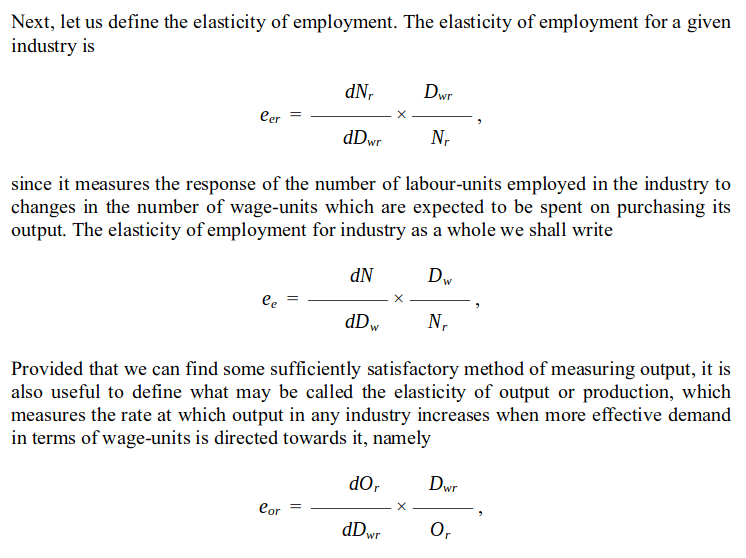
But Keynes did have math, and a lot of it. He formalized theories of supply and demand. He created mathematical objects describing consumption, investment, government spending, total demand, total output, stored inventory, employment, savings, taxes, and other financial instruments. And he then constructed a system of equations describing the relationships between instruments. Here’s a sample:

Screenshot from 2019-02-19 21.52.54


Analysis: Even though Keynes’ ideas have been replaced with more accurate models, he was influential in founding modern economics. He was one of the first people to create mathematical models of different economic theories, and his ideas helped lead to the big government policies of the 40s and 50s.

However, I am not writing a history paper. I am not including information on Keynesian thought because it was historically important, and especially not because it’s still relevant today – it isn’t. However, I think it is difficult to discuss Neokeynesian ideas without a firm understanding of what the Keynesian school was, so it will be included in the paper.

Post One: Capitalism as an Emergent System

Goetzmann, William N. Money Changes Everything. Princeton University Press, 2016.

Summary: This book talks about how economic systems emerge from first principles, showing that similar economic ideas, such as capital, loans, and even stock markets, were independently invented in many different societies over history. He discusses how most economies throughout history have been fairly similar, tending towards globalism and advanced financial instruments. However, there is also mention of more deliberate and planned economies, such as Marxism and Leninism, and how those differ from the more natural and emergent system present in most countries today.

Analysis: I am researching the differences between different schools of economic thought, such as Neoclassical, Austrian, and Neokeynesian. This book does not have comparisons between different economic schools as its focus, however, I think it will be very useful anyway, as it provides a strong background in economic theories. There are many terms used in other articles I do not yet understand, and I think this economics-from-first-principles book will help me to understand.

Additionally, I think this book has a very interesting viewpoint. By positing that the current economy is, at a high level, very similar to past economic systems, Goetzmann seems to suggest that the current way of doing things is natural, emergent, and somewhat inevitable. This seems to be a very strongly neoliberal idea, but I have not gotten very far in the book yet, so my initial impression may well be incorrect. I especially haven’t read his sections on communist and collectivist economies, so its still possible Goetzmann is a full blown anarcho-primitivist. But my initial impression of the book is very neoliberal capitalist.

Image result for william N Goetzmann
William Goetzmann

I am not yet sure if I will talk about collectivist economies in my paper. I am mainly interested in the differences between the capitalist schools of thought, because they are nuanced and mathematical and subtle. Capitalism vs Collectivism is a more philosophical debate. So I will probably not need Goetzmann’s chapters on communist China and Russia.

About Anthony

Anthony is upset wordpress gave him the domain 200.fashion.blog instead of dellingercomp200 or something. He thinks it’s because he already has a blog on this account for a scholarship and wordpress only gives one free wordpress.com domain, but maybe he’s just dumb and can’t use computers. But since he has a fashion blog url he feels that he should blog about fashion. Let’s try it:

Oversized sneakers with lots of added bits are the peak of 2019 culture. Especially if you wear them while at the Kutztown climbing wall. There is no flex more in vogue. Fleek. Yandhi. T-Pose.

Now that I’ve established my credibility as a fashion mogul, I’m supposed to embed videos and things to prove I know how. I’m just going to link to my other blog that already has all those things.

I’m also supposed to put a picture of me:2019-02-0611:20:49

Once again, I am the authority on modern fashion. Triple chins are the new haute couture.